CodeArrest Softwares Private Limited

Business growth

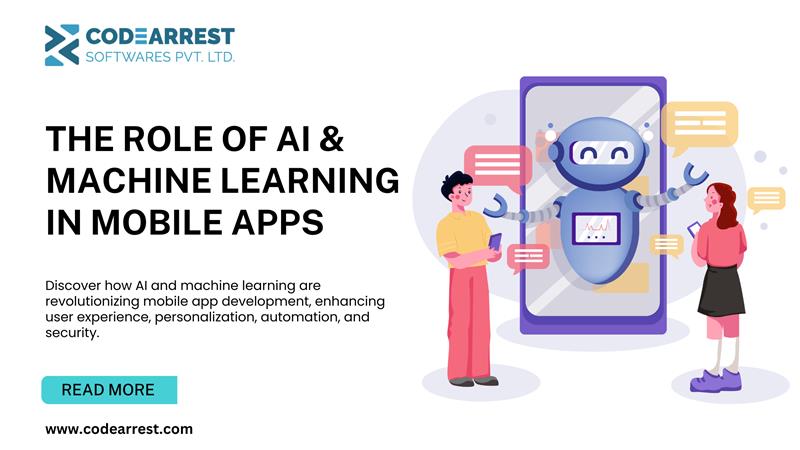
The Role of AI & Machine Learning in Mobile Apps

Introduction  Mobile App Development has undergone tremendous changes in the recent digital world due to the amalgamation of Artificial Intelligence (AI) and Machine Learning (ML). AI-Powered Mobile Applications punctuate the User experience, making the apps Smarter, Efficient, and Personal. AI and ML are radically changing the way the users interact with mobile applications starting from voice assistant applications like Siri and Google Assistant, to recommendation engines on Netflix and Amazon. This blog discusses the effects of AI and ML in Mobile App Development, their major applications and the benefits that these advantages.  The Growing Impact of AI and ML in Mobile App Development  Businesses are adopting new technologies such as AI and ML, which is why businesses are using AI-driven mobile applications to improve their efficiency and user satisfaction. One of the potential segments that are expected to make the latter part of the table is AI since recent studies indicate the global AI market in mobile apps is expected to grow massively making it one of the key components of future Mobile App Development trends in upcoming period. AI and ML help you not only enhance applications’ features but also help developers build insightful, data-driven, and automated solutions.  Key Applications of AI & ML in Mobile Apps  1. Personalized User Experience  By analyzing how users behave, what they like, and how they interact with the application, AI allows mobile applications to create personalized experiences. AI-powered recommendation engines are utilized by software such as Netflix, Spotify, or Amazon to personalize content, music, products, etc. That improves the engagement and increases the retention of users.  2. Chatbots and Virtual Assistants  AI-powered chatbots and virtual assistants offer immediate customer support services that help web creators engage users better. Mobile applications integrated with AI-driven bots can answer queries as well as provide recommendations and resolve issues efficiently. Mobile interactions have already been redefined with popular AI assistants like Siri, Google Assistant and Alexa.  3. Voice and Image Recognition  The AI-powered voice recognition technology of Apple’s Siri and the Google Voice Search, which enables users to interact with mobile apps without having to touch the screen. Likewise, image recognition in the form of Google Lens. Apps such as Snapchat allow the user to search, shop, and engage visually with minimal obstacles.  4. Predictive Analytics for Business Insights  Artificial intelligence (AI) and machine learning (ML) enable predictive analytics that assists businesses in analyzing user behavior and predicting future trends. It allows businesses to refine their marketing efforts, increase customer loyalty, and make better-informed decisions. Elements of this latter are already present in e-commercial apps, such as Amazon, which use AI-powered predictive analytics to recommend products and predict sales.  5. Enhanced Security with AI-Powered Authentication  The app security has been enhanced significantly by AI-powered security features like fingerprint scanning, facial recognition, and behavioral biometrics. AI-based fraud detection systems help banks and financial institutions to detect and prevent fraudulent payments, ensuring secure mobile banking experiences.  6. Automated Content Creation  Several AI content creation tools that let businesses create relevant and engaging material with little or no effort. Mobile applications such as Grammarly and QuillBot apply AI in grammar suggestions, paraphrasing, and content recommendation, therefore improving the productivity of the user.  7. Augmented Reality (AR) and AI Integration  Some examples of innovative applications in gaming, e-commerce, and real estate have sprung from the combination of AI and AR in mobile apps. For example, artificial intelligence (AI) powered augmented reality (AR) applications such as IKEA Place can locate furniture in a customer’s property location and enhance the online shopping experience for customers even before they make a purchase.  Benefits of AI & ML in Mobile App Development  1. Improved User Engagement Mobile apps aided by AI provide tailored experiences for users, resulting in enhanced user contentment and interaction. Predictive text, smart replies, AI-driven notifications, etc. will improve user interaction ultimately resulting in higher app retention rates.  2. Faster and Smarter Decision-Making  The AI algorithms analyze terabytes of data in real-time and make decisions in the mobile apps that tap on their models. In finance apps, for example, AI-based systems examine the trends of the stock market and give recommendations on investment.  3. Increased Efficiency and Automation  With AI, repetitive tasks are automated, thereby limiting manual intervention and making way for efficiency. Mobile application AI-powered automation allows the business to keep the operations streamlined which saves time and resources.  4. Enhanced Security and Fraud Prevention  We often have sensitive information on mobile applications, which increases the risk of cyber threats and fraud. AI fraud detection algorithms also analyze user behavior and detect anomalies that can render security breaches impossible.  5. Cost-Effective Development and Maintenance  AI automates testing, debugging, and quality assurance and has streamlines the app development process. Thus, decreasing development cost and boosting app performance, making Mobile Application Development more efficient and cost-efficient.  Future of AI & ML in Mobile App Development  In app development, AI offers great potential for the future, as new models in deep learning, natural language processing (NLP), and AI-driven automation continue to emerge. AI-powered integration with the emerging technologies such as 5G, IoT, blockchain; would also empower the mobile applications for enhanced functionalities. Businesses using AI inside their mobile apps will get a competitive edge, delivering innovative and intelligent solutions to their users.  Conclusion  When it comes to Mobile App Development, AI and ML are keeping on redefining the mobile app experience smarter, more intuitive, and very productive. AI-driven mobile applications are revolutionizing industries across the globe, offering personalized user experiences to improved security. To utilize AI and ML for delivering the best mobile applications, businesses need to keep pace with the ever-evolving competitive mobile application industry.  So, are you poised to make an AI-powered mobile app? Contact our professional Mobile App Development team at CodeArrest and elevate your business!  Contact us: +91 70738 99493 Info: sales@codearrest.co.uk

The Role of AI & Machine Learning in Mobile Apps Read More »
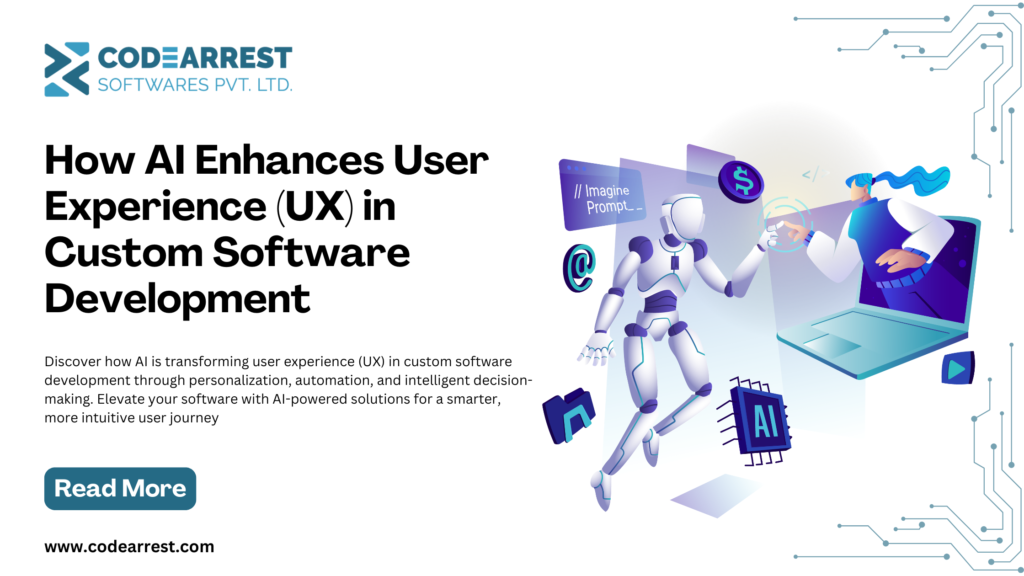
How AI Enhances User Experience (UX) in Custom Software Development 

Introduction  User Experience (UX) is the most crucial part of any application development software. However, being one of the must-haves features to make seamless, interactive, and personalized experiences the norm, AI integration is paramount as businesses continue to migrate to bespoke software development. Application development on the latest technologies like IoT, AI (artificial intelligence) and many more depends on up-to-date data, which is one of the most valuable assets. In this blog, we will talk about the role of AI in revolutionizing the UX in custom software development and will cover why you need AI-powered custom software solutions.  The Role of AI in Custom Software Development  The core of custom software development revolves around building applications aimed at solving specific business problems. AI integration takes these types of solutions and enhances them through data analytics, machine learning and automation, making them smarter and more user-friendly. That is why AI-driven software can anticipate user needs, streamline interactions, optimize performance, and enhance customer experience.  How AI Enhances UX in Custom Software Development 1. Personalization and User-Centric Experiences  AI algorithms track and input user behavior, preferences, as well as previous interactions in order to deliver tailored experiences. Recommendations of content, products, services, etc, based on user activity, are examples of machine learning models which can be used to provide a more delightful experience for users. This is highly advantageous for businesses in e-commerce, entertainment and other content-heavy applications sectors.  2. AI-Powered Chatbots and Virtual Assistants  AI-powered chatbots and virtual assistants provide immediate customer service and recommendations to enhance the user experience through real-time support. Each AI chatbot is built with Natural Language Processing (NLP) capabilities that help it understand user intent and respond accordingly with best fit, timely, and relevant answers to customer queries so that reliance on human agents can be reduced, and customer engagement can be improved.  3. Enhanced UI/UX Design with AI  AI which helps designers and developers understand user behavior to optimize the interface. AI-powered design tools can suggest alterations to layouts, color palettes, and navigation from real user data. This makes the software look pretty and easy to use.  4. Improved Accessibility  From voice recognition to text-to-speech to automated subtitles, AI-powered accessibility features can make software easier for those with disabilities to use. Apart from that AI is also too inclusive by bringing the digital platform to users.  5. Predictive Analytics for Better User Engagement  AI can also examine user behavioral patterns that would assist in anticipating their requirements and providing proactive suggestions. Using predictive analytics, businesses can forecast the needs of their customers on a micro level by optimizing their marketing and increasing overall engagement.  6. Automation and Workflow Optimization  Most of the operations are maintained through automation led by AI, which increases your efficiency and saves additional manual efforts on handling complex workflows. AI also streamlines tasks and conventional processes clearing human errors and creating seamless operations which leads to a greater user experience.  7. Enhanced Security and Fraud Detection  AI also enhances security in custom software development by detecting anomalous behavior, threats detection, and fraud prevention. Related technologies such as anomaly detection and biometric authentication enhance the accuracy of prediction without compromising their data privacy and protection.  8. Sentiment Analysis for User Feedback  By using AI powered sentiment analysis tools, businesses can study customer reviews, social media posts, and support tickets to get a clearer view of what users think about their product, and even their competitors. Why Businesses Should Invest in AI for Custom Software Development  AI is changing things for every sector, which is why companies should be harnessing AI solutions to stay ahead of the curve. AI offers ways to enhance efficiency, user experience, and scalability, which is why it is such revolutionary technology when it comes to custom software development. Integrating AI allows businesses to create smarter, more adaptable software to keep up with changing customer expectations.  CodeArrest: Transforming Custom Software Development with AI  CodeArrest is an expert at implementing AI-powered solutions in custom software development to create the best user experience. Therefore, it stands to reason our AI-based approach guarantees a scalable, secure and highly customized software solution for businesses. CodeArrest enables businesses to leverage AI, be it through AI-powered chatbots, predictive analytics, or automation for improved UX and operational efficiency.  Conclusion  AI is reshaping custom software development by judiciously increasing UX by means of personalization, automation, and intelligent decision-making capabilities. Companies that have not yet adopted AI-based solutions to enhance customer interaction, availability, and security should do so. AI-powered software allows companies to build user-friendly, productive, and incredibly interactive digital experiences, giving them a clear edge over the competition.  Contact us: +91 70738 99493 Info: sales@codearrest.co.uk

How AI Enhances User Experience (UX) in Custom Software Development  Read More »

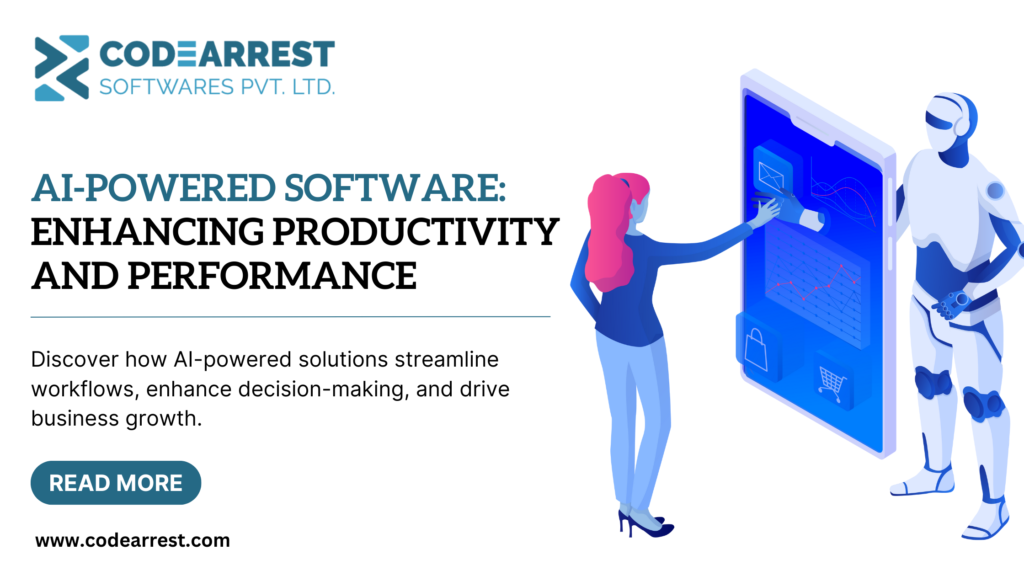
AI-Powered Software: Enhancing Productivity and Performance

Introduction  AI-powered solutions are changing the way businesses operate, making processes efficient, automated, and consequently intelligent. Hence, modern AI-based software automates monotonous and repetitious tasks allowing you to focus on value-generating ones. Integrating AI into software solutions allows organizations to gain a competitive edge, reduce costs, and improve operational efficiency. In this blog, we will discuss how Ai-based software improves productivity and performance in various fields.  The Role of AI in Boosting Productivity  AI-Powered Solutions are built to automate, predict, and optimize processes that typically need some degree of human involvement. Using machine learning, natural language processing (NLP), and robotic process automation (RPA), companies can:  How AI-Powered Software Enhances Performance  AI-powered automation is not about replacing manual work; rather, the focus is on augmenting the performance of people, systems, and underlying business processes. Let’s take a look at AI-powered solutions to help you increase productivity and performance:  1. Intelligent Automation of Repetitive Tasks Inefficient routine administrative operations including data entry, generating reports, sending replies through email, etc. are very time-consuming. AI-driven automation tools can simplify these processes, giving employees the time to do higher-value tasks that will help fuel business expansion.  2. Smart Decision-Making with AI-Powered Analytics  AI processes extensive data collections to detect patterns, trends, and actionable insights. AI can help businesses with smarter decision-making, trend prediction and development, optimizing business operations, etc.  3. AI-Powered Customer Support & Engagement  AI chatbots and virtual assistants automate many tasks, delivering 24/7 support for consumers which then leads to quicker and more contented consumers. AI-driven solutions provide personalized recommendations, improving the overall customer experience by analyzing customer behavior and preferences.  4. Enhanced Cybersecurity with AI-Based Threat Detection  AI improves security by detecting threats, analyzing vulnerabilities, and responding to cyberattacks in real time. And AI-powered security solutions also help organizations safeguard their information, avert fraud, and maintain regulatory compliance.  5. Personalized User Experiences  AI-driven software connects us in different ways according to our preferences and histories. AI-powered systems track user behavior, allowing for personalized experiences based on individual preferences.  6. AI in Supply Chain and Logistics  Supply chain management and logistics is another area where AI reduces manual labor and increases efficiency. AI-powered predictive equipment analytics enable enterprises to save costs, and increase delivery timeliness, and usage while reducing disruption.  AI-Powered Solutions at CodeArrest  At CodeArrest, we provide innovative AI-powered solutions to boost productivity and performance for businesses. Powered by our AI-driven action-based software solutions, we enable to:  CodeArrest also empowers companies to gain a competitive advantage and achieve operational excellence by incorporating AI in custom software development.  Future Trends in AI-Powered Software  The world of AI continues to expand as new technologies will shape the future of productivity and performance. Some key trends include: Conclusion  AI-powered software, when implemented, increases productivity and performance across various industries. AI-based systems enable companies to optimize operations, increase efficiency, and drive innovation, from intelligent automation to advanced analytics. Those organizations that embrace AI-powered solutions will discover new avenues for growth and enjoy a highly competitive edge.  CodeArrest provides innovative AI-powered software solutions for your business. All set to take your business to the next level? Reach out to us now to give AI-driven automation a shot!  Contact us: +91 70738 99493 Info: sales@codearrest.co.uk

AI-Powered Software: Enhancing Productivity and Performance Read More »

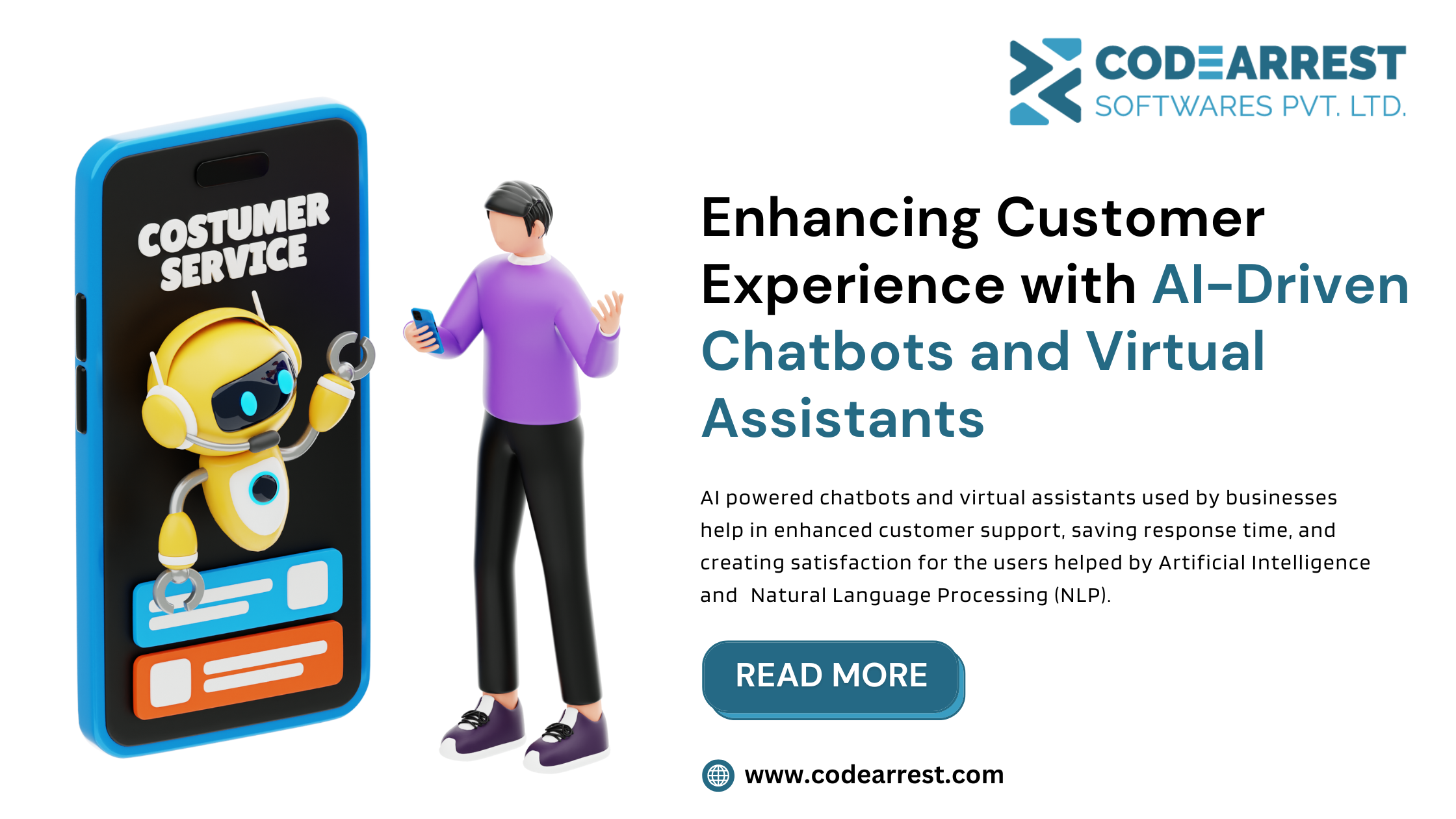
Enhancing Customer Experience with AI-Driven Chatbots and Virtual Assistants 

Introduction  Businesses today are constantly on the lookout in the digital landscape to provide a better customer experience. One of the most dominant AI-powered solutions you can say is shaping customer interactions are chatbots and virtual assistants. These systems are revolutionizing the way businesses engage with their customers, providing faster, more personalized and therefore more efficient and effective services.  The Rise of AI-Powered Solutions in Customer Service  AI powered chatbots & virtual assistants used by businesses help in enhanced customer support, saving response time, and creating satisfaction for the users helped by Artificial Intelligence and Natural Language Processing (NLP). No matter how simple or complex, AI-powered solutions are changing customer service operations across industries, from answering simple queries to solving complex support tickets.  How AI-Driven Chatbots and Virtual Assistants Enhance Customer Experience  1. 24/7 Availability and Instant Responses   While human customer service agents can only work during set business hours, AI chatbots and virtual assistants can work around the clock. They can answer customer questions instantly, lowering wait times, so customers receive the help they need at any time and any place. This increases general fulfilment and constructs buyer trust. 2. Personalized Customer Interactions  Using AI-powered solutions, customer behavior, purchase patterns, and previous interactions are studied to serve customers with personalized responses. This essentially helps brands to make the customer journey a lot more engaging and seamless by having the use of virtual assistants which can help in recommending products, solutions based on user preferences as well as providing hosted personalized offers.  3. Handling Multiple Customer Queries Simultaneously  Unlike humans, who can answer a handful of people at a time, AI-based chatbots can serve thousands of customers at once. Introduction to such huge scalability will allow the establishment itself to manage their huge number of laboratorial requests easily which will also save them from overhead costs also will enable them to easily rearrange each aspect of their service.  4. Seamless Integration with CRM and Other Business Tools  AI chatbots & virtual assistants are being implemented in applications like CRM systems, and emails visualizer, eCommerce websites, etc. Such integrations are only possible with applications that assist firms in providing a uniform and deliberate support experience across touch points for data sharing.  5. AI-Powered Sentiment Analysis for Better Engagement  AI-driven solutions can analyze customer sentiment while a customer talks to a business through text or voice. It also offers other insights that enables companies to be proactive in their customer experience improvement, say, escalating a ticket to a human agent when the customer reaches a certain level of frustration threshold, or sending out a follow-on after a support query if the company hasn’t yet received a response.  6. Automated Issue Resolution and Self-Service Options  AI chatbots and virtual assistants can also solve problems with an answer in place that enables self-service, lessening the human touch. This increases efficiency but enables customers to self-service, which leads to higher customer satisfaction.  Use Cases of AI Chatbots and Virtual Assistants in Different Industries  E-commerce and Retail  Banking and Finance  Healthcare  Travel and Hospitality  Future Trends in AI-Powered Customer Service The prospects for AI-powered solutions in customer service are promising with advanced innovations in NLP, AI, machine learning, and even voice recognition in the offering. Some emerging trends include:  CodeArrest: Empowering Businesses with AI-Powered Solutions We at CodeArrest excel in AI-Powered Solutions which helps in enhancing your customer experience and effective execution of business operations. Achieving efficiency, higher customer satisfaction and scaling your business will be our cutting-edge chatbots and virtual assistants. You may be looking for AI-based automation, bespoke software development, and complex analytics, CodeArrest supplies advanced technology for whatever your organizations require.  Conclusion  AI-powered chatbots and virtual assistants are transforming customer experience with instant, personalized and efficient support. The ability to use AI-powered solutions in a customer service strategy delivers a competitive advantage, better customer engagement, and optimized operations. With continuous AI development and advancements, companies that adapt will not only generate leads effectively but also thrive in the digital world through intelligent chatbots.  CodeArrest offers cutting-edge AI-powered solutions designed to improve customer engagement and deliver successful outcomes for organizations seeking to integrate AI-based customer service solutions.  Contact us: +91 70738 99493 Info: sales@codearrest.co.uk

Enhancing Customer Experience with AI-Driven Chatbots and Virtual Assistants  Read More »

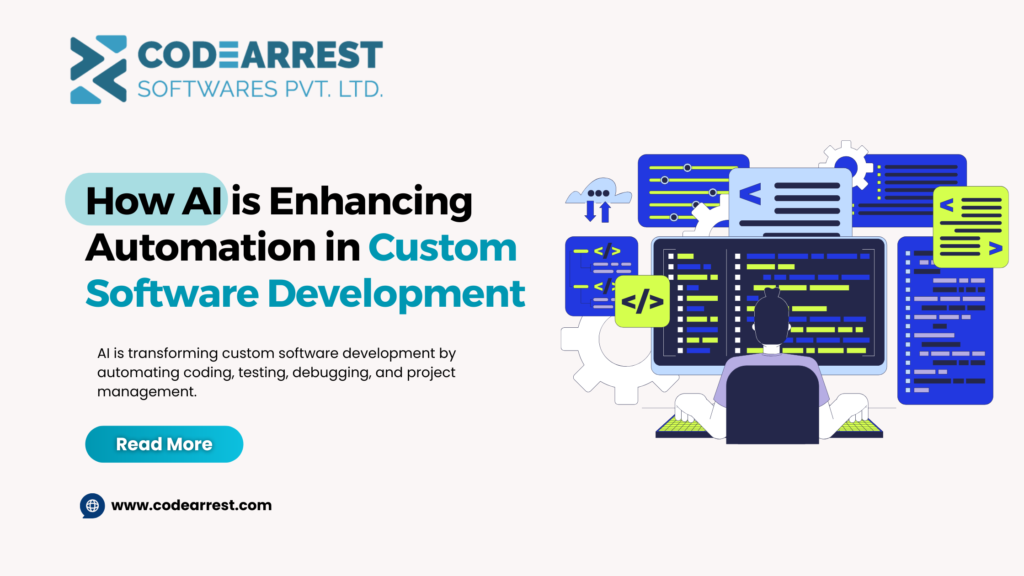
How AI is Enhancing Automation in Custom Software Development 

Introduction  Custom Software Development is increasingly being used by businesses to cater to their specific process requirements in the rapidly transforming world of the internet. Yet, conventional software development iterations can be tedious, not without mistakes, and expensive in terms of resources. This is where AI is contributing to disrupting this sector by automating several aspects of the development process from code generation to testing and thus increasing efficiency and accuracy. Automation in custom software development powered by AI is a trend that is likely to stay.  In this blog, we will explore how AI can transform various areas of custom software development through automation, benefits, and what it looks like for businesses to embrace AI infused solutions driving productivity and innovation respectively.  The Role of AI in Custom Software Development  AI is assisting in custom software development by optimizing the process, reducing the need for human intervention, and thus speeding up the process for overall delivery of the project. Here are some AI initiatives that automate this space:  1. Automated Code Generation  AI-based tools can write up quality code based on requirements given, which saves the amount of time developers must write redundant code. These tools scan existing codebases, recommend fixes, and find problems in real time.  Example: OpenAI’s Codex and GitHub Copilot help developers by writing code snippets using simple instructions.  2. AI-Driven Software Testing  Testing is an essential step in the custom software development process to guarantee that the result is free of errors and functions effectively. Testing processes can be automated by AI with:  Example: Tools like Testim and Applitools contain machine learning algorithms that optimize and automate the generation of test cases, minimizing manual testing efforts.  3. Automated Bug Detection and Fixing  AI algorithms can screen thousands of lines of code for bugs, errors and security weaknesses. In comparison to the existing human-centric debugging, AI-based debugging works faster with less human interference.  Example: Facebook created AI-powered tool SapFix to automatically identify and resolve bugs to automate the software development process.  4. Intelligent Project Management  Artificial intelligence-based project managers help streamline the workflows of a custom software development by:  Example: JIRA and Trello can be fed with Artificial intelligence and can be very accurately used to track project status and manage tasks.  5. Automated UI/UX Design Enhancement  With AI, user experience (UX) and user interface (UI) design can be improved since this technology can study the behavior of users and create use cases to make design recommendations. It assists the developers in the design of software applications that are user-friendly and intuitive.  Example: Adobe Sensei processes previous design patterns and recommends layouts using AI.  Key Benefits of AI-Driven Automation in Custom Software Development  By automating repetitive tasks, AI greatly shortens the time needed for software projects to be developed and eventually launched by shortening development time and time-to-market.  There are no human errors in the automated work done by AI, resulting in excellent optimized and bug-free software. With automation of important development processes, the businesses do not have to hire extra resources for project development, which further decreases the cost of development.  Utilizing AI, these tools can identify and remediate weaknesses in software even before they are exploited by attackers, strengthening and securing software from possible cyber attacks.  Due to this potential, AI-based custom software development allows organizations to effortlessly auto-scale applications as per the user requests and real-time data processing.  Real-World Applications of AI in Custom Software Development  1. AI in E-Commerce Software  AI-driven recommendation engines study customer actions and provide tailored product recommendations, which in turn boosts sales and engagement.  Example: AI-based automation is used by Amazon and Netflix to create personalized shopping and viewing experiences. 2. AI in Healthcare Software  AI reduces the time taken for medical data analysis, patient diagnosis, and the recommendation of treatment, hence, making our health care more efficient.  Example: The AI domains in use to help doctors diagnose diseases and recommend treatments for IBM Watson.  3. AI in Financial Software  In banking and finance, machine learning can be used for automated fraud detection, risk assessment, and chatbot-driven customer support.  Example: AI Chatbots like Erica (Bank of America) make transactions and answer finance questions.  How Businesses Can Leverage AI for Custom Software Development  For those wanting to include AI automation with their personalized software development, look at these simple steps:  1. Identify Areas for Automation  Try to figure out which of the processes you could best benefit from AI-based automation in the development workflow. For some of it such as testing, debugging, code generation. 2. Choose the Right AI Tools  Make use of AI-enabled development platforms like:  3. Collaborate with AI Experts  But to maximize the automation magic of artificial intelligence, coordinating with specialists or hiring AI developers on board which helps your software development process would benefit the business.  4. Ensure Data Security and Compliance  AI-powered software needs to comply with security protocols and categorize with data compliance standards like GDPR and HIPAA, when it comes to data security.  Final Thoughts  AI automation is transforming software development by producing better, faster, and cheaper custom software. From auto-generating code to smart test management and debugging, AI is disrupting the way companies deliver their software solutions.  Embracing AI-Powered Automation to Optimize Development Workflows AI-enabled automation helps organizations leverage their development pipelines. These can include automating the test process, application deployment process, etc. Well, if you are looking to merge the endless potential of AI-led automation into your custom software development then you have come to the right place!  Need AI-Powered Custom Software?  CodeArrest is an expert in AI powered Custom software development according to business needs. Contact us to craft agile automated solutions that lead to success!  Contact us: +91 70738 99493 Info: sales@codearrest.co.uk

How AI is Enhancing Automation in Custom Software Development  Read More »

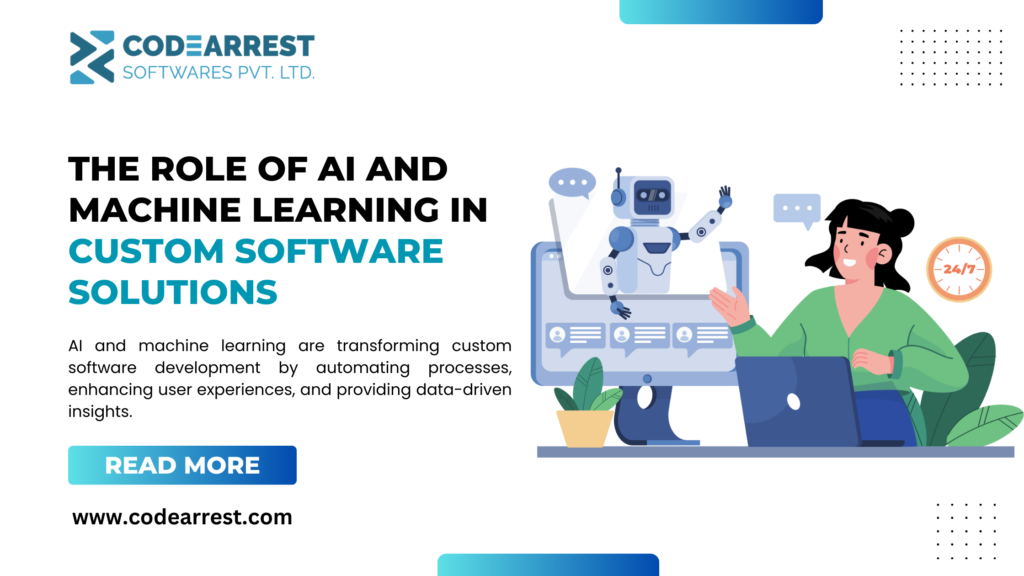
The Role of AI and Machine Learning in Custom Software Solutions

Introduction  Artificial intelligence (AI) and machine learning (ML) are sending the widespread software and changeable providing a radically new experience for Developers and Designers. And now, different types of business such as eCommerce portals or financial process have started employing these AI and ML solutions within the system to be eventually fast, automated, and smart through the data. Artificial Intelligence is a rapidly growing field, covering topics such as natural language processing, machine learning, and brain-computer interfaces.  This blog will talk about the impact of AI and ML on custom software development, its advantages, real-world applications, and why business should use them.  Understanding AI and Machine Learning in Custom Software Development What is Custom Software Development? Custom software development allows you to create software tailored to the needs of any given business. Custom software solutions offer flexibility, scalability and customization functionality commercial software cannot replicate, taking them in the direction of making them more aligned with an organization’s objectives.  What Are AI and Machine Learning? With AI and ML integration, custom software solutions enable organizations to develop performance apps that adjust and grow automatically with changes of user behavior, business process & market structure, etc.  How AI and ML Enhance Custom Software Development  1. Automating Business Processes  Such mundane and time-consuming tasks could be automated with tailored software with artificial intelligence that could, for instance, deliver any of some repetitive tasks such as customer service, document handling, or data input, etc. This cuts down on human intervention, reduces errors, and boosts operational efficiency.  2. Personalized User Experience  AI in personalized marketing: AI algorithms drive recommendations, making real-time decisions based on user behavior, personalized content and interactions. Dynamic user engagement is enabled through the use of e-commerce platforms, streaming services, and customer service chatbots using this technology.  3. Advanced Data Analytics and Insights  Companies use Machine Learning to extract valuable insights from Big Data. Using AI-powered analytics tools that identify patterns, trends, and anomalies, organizations are creating data-driven decisions and business strategies.  4. Intelligent Chatbots and Virtual Assistants  Chatbots and virtual assistants powered by AI improve customer service by responding instantly, responding correctly to queries, and automating customer interactions. Such AI-powered applications improve consumer interaction alongside lowering costs of operation.  5. Predictive Analytics and Forecasting  Machine learning algorithms are capable of meeting this need and can process historical data to forecast future trends, sales, customer behavior, and market demand. Predictive analytics in business refers to the process of using data to predict future business trends or outcomes.  6. Enhanced Security and Fraud Detection  These AI-powered security systems monitor user behavior, identifying anomalies and thwarting cyber threats. AI is used to detect fraudulent transactions for payment and e-commerce applications.  Real-World Applications of AI and ML in Custom Software Development  1. Healthcare Industry  AI-driven custom software supports disease diagnosis as well as medical image analysis, baseline prediction, and outcome prediction, etc. Based on the data retrieved from a machine learning model trained on health care data, doctors can now provide personalized treatment options for their patients, thus improving the quality of health care.  2. Finance and Banking  Banks conduct automatic transactions using AI and ML, detect fraud, and give you personalized regimented finance advice. They process market data and recommend investing options on behalf of their users.  3. E-commerce and Retail  For example, AI-based systems can suggest merchandise based on the consumer preferences and search history, at online stores, webpages or some other forms of content. Chatbots provide immediate customer assistance, predictive analysis, and precise supply chain management.  4. Manufacturing and Supply Chain AI reduces production costs, increases production efficiency by predicting when equipment is likely to fail, optimizing supply chain logistics, and automating many of the processes in quality control. Demand is forecasted and supply chain disruptions are avoided using machine learning models.  5. Education and E-Learning  Based on the students’ learning data AI-based custom software recommends personalized educational contents based on the performance. Virtual teaching assistants and automated testing systems help to teach.  Why Businesses Should Invest in AI-Powered Custom Software Development 1. Competitive Advantage  Thus, software solutions integrated with AI and ML will provide improved operational efficiencies, reduced costs, improved customer experience, etc.  2. Scalability and Flexibility  The AI driven software has been designed in such an interactive manner that it knows exactly how the new business needs to adjust in organization so that the process can transformed accordingly to recognize the traditional path of work can/directly relating to the existing solution variable.  3. Cost Efficiency  Automation of these processes can also help in the management of shipping and resources and minimizes the errors that surface at the end resulting in the final costs.  4. Improved Decision-Making  Real-time analytics powered by AI enables organizations to develop data-driven decisions to foresee and identify growth opportunities and mitigate risk.  How CodeArrest Powers Businesses with AI-Driven Custom Software  At CodeArrest, we are a group of skilled developers, passionate about AI and building software to help companies succeed. Expertise in AI solutions with data analytics/machine learning, developing smart applications specific to your application. Whether that’s process automation, predictive analytics or AI powered customer engagement tools, CodeArrest offers innovative yet scalable software solutions that will help improve your bottom line and ROI.  Conclusion  Intelligent, fast, incredibly customized solutions for businesses made way for AI and machine learning, which changed the face of custom software development solutions. AI-enabled software is revolutionizing everything from automation and personalization to predictive analytics and security across a range of industries. Tailor made Software helps in streamlining business processes and helps enterprises prepare for long-term success in a competitive digital landscape.  You want to be the client of a new era, ready to fuel your custom software solution with AI or ML? CodeArrest is here to help. Get in touch with us today to find out about unique AI-powered software solutions for your company.  Contact us: +91 70738 99493 Info: sales@codearrest.co.uk

The Role of AI and Machine Learning in Custom Software Solutions Read More »

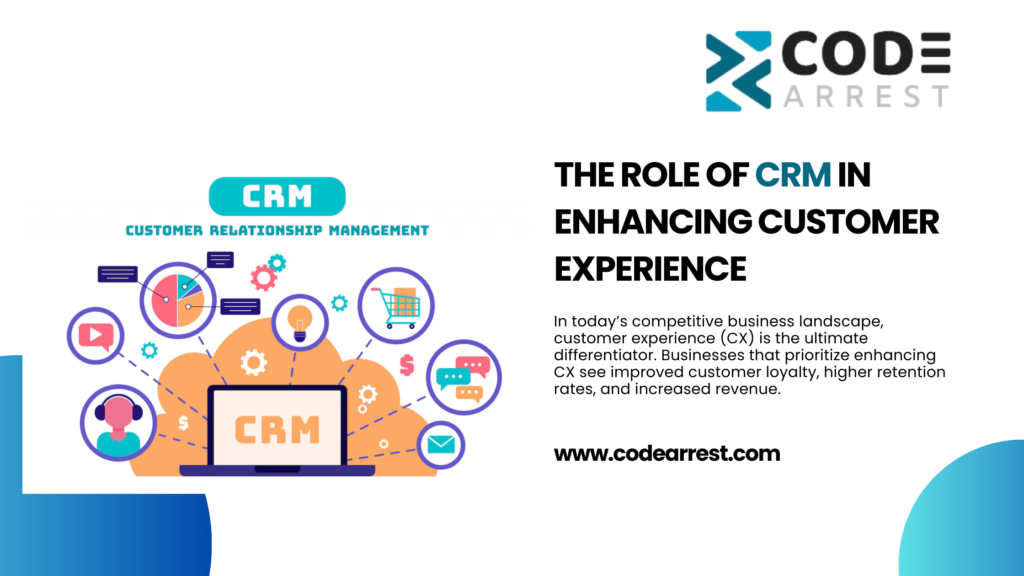
The Role of CRM in Enhancing Customer Experience 

Customer experience (CX) is the biggest differentiator in today’s world of competitive business. Going all in on customer experience (CX) keeps the customers you have, increases retention rates, and makes a whole bunch more money. The best solution that can help you with this is a well-built Customer Relationship Management (CRM) system. Through this blog, we shall understand the significance of CRM development for improving customer experience and its importance for every business.  What is CRM Development?  CRM development is the process of creating, customizing, and deploying CRMs to meet specific business requirements. These solutions have helped with a variety of processes from customer data management to interaction tracking, and other processes. A good CRM system may allow better centralization on customers related information, regardless of whether your organization is a small business or a big enterprise, so your team can provide the best of supportive and personalized service.  How CRM Enhances Customer Experience  1. Personalization Through Data Insights  This means that in a time of customization, customers are expected to have some control over personalization as businesses will be expected to know what their customers want and serve them accordingly. CRM software collects and organizes customer information such as purchase history, behavior patterns, and preferences. Armed with this data, businesses can forge personalized recommendations, targeted deals and even understand customer behaviour.  With CRM implementation, an e-commerce company can email customers about products according to their browsing history. Customers are much more likely to engage with brands when they feel acknowledged and valued.  2. Seamless Communication Across Channels  Nowadays, customers reach out to the businesses over a multiverse of channels like; social media, emails, telephone, and even chatbots. There aren’t centralized systems that track all these interactions. CRM unifies every means of communication and all customer data into a single view.  So, for example, if a customer contacts you through social media, and then calls the support team, a CRM system makes sure that the support team knows about the previous interaction. Their records are all dynamic, showing up in real-time allowing seamless communication between departments and eliminating the need for customers to repeat themselves for different departments.  3. Faster Response Times  One of the pillars of great customer service is a rapid reaction to customer inquiries. A CRM automates ticket allocation, inquiry monitoring, and urgency assignment for problems that need prioritization. Automation with structured workflows, businesses can churn out better responses to customers  In addition, CRM tools can provide self-service portals, FAQs and AI-powered chatbots, helping customers find answers at their own pace without having to wait for a human to respond.  4. Proactive Customer Service  Another major advantage of CRM development is the possibility to provide proactive service. A CRM system is capable of recognizing potential problems in advance through customer data analysis. For example, if it is time for the subscription to renew, a CRM can automatically send reminders or offer discounts or other incentives for early renewal.  Proactive service not only creates trust but is also a way for your business to show that you actually care about your customers and are not a single-use business, resulting in long-term loyalty.  5. Improved Employee Collaboration  Let’s keep in mind that an exceptional customer experience is a team effort. CRM offers one integrated view of client data to facilitate inter-departmental collaboration. Synchronization of information is the first step to productive collaboration between departments like sales and marketing, or sales and customer support. It also nurtures a seamless approach.  For example, when a prospect becomes a customer, the sales team should be able to write down new customer’s information in the CRM and that information can then be utilized by the marketing team for personalized campaigns to that specific prospect. This collaboration leads to a more seamless customer journey and improved results.  6. Tracking Customer Feedback  Product and services improvement relies on customer feedback. The process of collecting and analyzing feedback becomes much more streamlined with CRM systems. Through the integration of surveys and feedback forms within the CRM, companies can obtain actionable insights regarding what customers love and what needs improvement.  These insights do not only help to narrow customer experience but improve the relationship between customers and the business that shows the voice of consumers matters.  7. Loyalty Programs and Rewards  The best CRM should be able to help you build & manage customer loyalty programs seamlessly. You can monitor the purchases of customers and provide discounts, special offers, or custom gift items to repeat customers  Customer experiences are boosted by loyalty initiatives, which also promote repeat business and word-of-mouth advertising.  Why CRM Development is Essential for Enhancing CX  If the CRM strategy used by a company is completely unique to that company, then it may or may not provide the expected results. CRM development enables organizations to enhance their systems according to their respective sales processes, business objectives, and end-user needs.  The demands of customers grow along with your business. Also, a custom CRM system is scalable which means that it grows along with your operations. Whether you’re adding new features, integrating with other tools, or accommodating a wider customer base, a well-developed CRM system grows along with you.  Unlike specific applications, CRM development can simply be integrated with other CRMs and data sources. The whole system works only if all the components are interconnected for seamless operation and present a great customer experience.  The Future of CRM and Customer Experience  The future is bright for CRM systems with the progress of technology. CRM tools will only get better with the improved reporting about AI driven analytics, predictive modelling, and advanced automation. Companies that will focus on CRM development this year will find themselves with the best tools to provide their customers with an experience of a lifetime in the future.  Moreover, emphasis will be on immediate customer interaction, utilizing analytics for quick resolutions and tailored experiences. CRM technology will have a major evolution, and this will help the businesses to stay competitive and customer-centric.  Conclusion  In the digital age, which we are living in, customer experience is the way to success followed by CRM since

The Role of CRM in Enhancing Customer Experience  Read More »

Why Custom Software is the Right Choice for Your Business

Why Custom Software is the Right Choice for Your Business?

In the dynamic realm of modern business, technology stands as a pivotal force driving progress. The choice between off-the-shelf solutions and custom software development is a critical decision that significantly impacts the trajectory of a business. This comprehensive guide delves into the myriad reasons why opting for custom software is the ideal choice, equipping businesses to harness innovation and efficiency tailored to their unique needs. Introduction: In the fast-paced landscape of technological advancements, businesses face the crucial decision of selecting the right software solution. Off-the-shelf options may seem convenient, but do they truly meet the specific demands of your business? This guide explores the inherent benefits of custom software development, unlocking a realm of possibilities for businesses aspiring to reach new heights. Understanding Custom Software: Custom software, in essence, is tailored to meet the specific needs of a business. Unlike off-the-shelf solutions that offer a one-size-fits-all approach, custom software development crafts solutions from the ground up, aligning precisely with the unique requirements and goals of a business. This bespoke nature sets the stage for a range of advantages that off-the-shelf alternatives struggle to match. Challenges of Off-the-Shelf Solutions: Before delving into the benefits of custom software, it’s crucial to acknowledge the limitations of off-the-shelf solutions. These pre-packaged software options might appear cost-effective and readily available, but they often fall short in addressing the specific intricacies and nuances that set your business apart. Limitations in flexibility, scalability, and customization become apparent as businesses strive for innovation and growth. The Power of Tailored Solutions: The primary allure of custom software lies in its ability to align with the unique needs and objectives of a business. By tailoring every aspect of the software to specific requirements, businesses can unlock unprecedented potential. From streamlining operations to enhancing user experience, custom solutions become a catalyst for innovation and efficiency. Scalability and Flexibility: One of the foremost advantages of custom software is its scalability and flexibility. As businesses evolve and expand, the software should seamlessly grow to accommodate increased demands. Off-the-shelf solutions often struggle to scale efficiently, leading to operational bottlenecks. Custom software, designed with scalability in mind, ensures that your technology infrastructure aligns with your business’s growth trajectory. Enhanced Security Measures: Security is a paramount concern for businesses in the digital age. Off-the-shelf solutions, being widely used, present a common target for cyber threats. Custom software development allows for robust security measures to be implemented from the ground up. Tailored security protocols, encryption methods, and access controls fortify the software against potential vulnerabilities, safeguarding sensitive business data. User Experience Matters: In a competitive business landscape, user experience (UX) can be a key differentiator. Off-the-shelf solutions often provide generic interfaces that may not align with the specific preferences and workflows of your team. Custom software, on the other hand, enables the creation of intuitive, user-friendly interfaces that enhance overall satisfaction and productivity. Integration Capabilities: Businesses rarely operate with a single software solution. Custom software facilitates seamless integration with existing systems and applications. This integration capability ensures that different aspects of your business function cohesively, eliminating silos and improving overall efficiency. Cost-Effectiveness in the Long Run: While the initial cost of custom software development might appear higher than off-the-shelf alternatives, the long-term financial benefits often outweigh the upfront investment. Custom solutions are designed to meet specific needs, reducing the need for constant adjustments and workarounds. This results in long-term cost savings and a higher return on investment. Speed and Efficiency: Custom software development allows businesses to prioritize essential features and functionalities, avoiding the bloat that comes with off-the-shelf solutions. This streamlined approach enhances the speed and efficiency of the software, providing users with a responsive and agile platform that aligns precisely with their requirements. Maintenance and Support: The journey with software doesn’t end with deployment; it requires ongoing maintenance and support. Custom software development teams are intimately familiar with the intricacies of the solution, enabling prompt updates, bug fixes, and support tailored to the unique architecture. This ensures a reliable and optimized software experience over time. Real-world Success Stories: Exploring real-world success stories of businesses that have embraced custom software offers tangible evidence of its transformative power. Case studies from diverse industries highlight how tailored solutions have driven efficiency, innovation, and growth for businesses facing unique challenges. Choosing the Right Development Partner: Selecting the right development partner is crucial for the success of a custom software project. Factors such as experience, expertise, and a collaborative approach should guide this decision. Engaging with a reliable development team ensures that your vision is translated into a robust, functional, and scalable software solution. Future Trends in Custom Software: The world of technology is ever-evolving, and custom software development is no exception. Anticipating future trends allows businesses to stay ahead of the curve. From the integration of artificial intelligence to the rising importance of cybersecurity, understanding these trends empowers businesses to make informed decisions about their software strategies. Conclusion: In conclusion, the choice between off-the-shelf solutions and custom software is a pivotal decision that shapes the digital landscape of a business. Custom software development emerges as the frontrunner, offering unparalleled advantages in scalability, security, user experience, and cost-effectiveness. As businesses strive for innovation and efficiency, the bespoke nature of custom software becomes the catalyst for transformative success.

Why Custom Software is the Right Choice for Your Business? Read More »